| Shop Our Online Store: | ||
 Since 1980!
|
Momentum 98
Natural Health Store
Taking
Advantage of
the Moment!
Propelling Yourself into Greatness! |
3509 North High Street, Columbus, Ohio 43214 Email: moment98@gmail.com |
|
AMERICAN BIOLOGICS
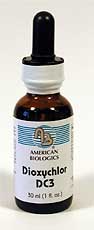
** BEST SELLER ** DIOXYCHLOR DC3 Go to American Biologics Homepage
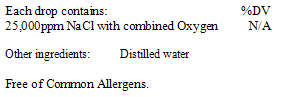
Dioxychlor is a special formulated homeopathic dilution of oxidized natrium chloride containing biologically important trace minerals. This product contains no sugar, starch, preservatives, artificial colors or flavors and is yeast, corn, rice, milk and gluten-free. This is American Biologics' well researched proprietary oxidizing agent. DC-3 has little or no stimulation of the free radical cascade, and is an excellent support to the treatment of intracellular viral states, Candida albicans, environmental toxicity, etc. Dioxychlor is highly recommended in a number of well-known books on nutrition, including The Prescription for Nutritional Healing, by Dr. James & Phyllis Balch, and Holistic Protocol for the Immune System, by Scott Gregory. Recommend use: Recommended use may vary. Sensitive individuals may start with 1 or 2 drops and build up to 20 drops. Others may take up to 40 drops. We have a number of research papers available on oxidizing agents. Research studies from around the world indicate that the product is extremely effective when used on the following conditions: • Gum inflammation (periodontis) • Candida Albicans • Immune System Problems Other uses for
Dioxychlor: • Insect bites: • Cuts • Food Poisoning/ Amebic Dysentary or Diarrhea • Bacteria
Contamination on Food(vegetables, seafood, poultry, pork): Dosage: Sublingual: 5-10 drops, one to three times daily, under the tongue, holding for 1 minute before swallowing. Oral: From 5-10 drops in 3 oz of water. Should sever "die off" occur (Hexheimer reaction, which may cause nausea and diarrhea), decrease dosage to patient tolerance. Once to two times per day, based on patient tolerance. Vaginal Douche: 40
drops in 3 oz (4droppers) of distilled water. (Optionally you may add
approximately 6-8 drops fresh lemon juice to acidify.) Retain 3
minutes. After 1 hour, use retention douche of 3 oz of distilled water
with approximately 3 tbs of Bio-Bifidus blended to the consistency of
cream (to replenish flora). Rectal: Generally the same as Vaginal Douche protocol, but do not use lemon juice. Nasal Douche: Add 30 drops to 1 oz of distilled water. Stir and sniff 1 dropper full of dilute solution in each nostril and repeat 1 minute later. Gargle with balance of solution and then expectorate. One to three times per day. Ear: The same solution as Nasal Douche protocol. Use dropper to put one dropper of dilute solution while tilting head. Mouthwash: 20-40 drops in 3 oz of water, retain and agitate for 2 minutes, then expectorate. For thrush, canker sores, etc. three times a day until symptoms abate. 1 to 3 drops full strength may be put directly on canker sores. Topically: Put
directly on finger and toe nails and skin lesions. Not recommended for face. MORE ABOUT DIOXYCHLOR Dioxychlor, one of a class of inorganic oxidants, has been found useful against the three major classes of infective agents: virus, bacteria and fungi. They have tremendous potential use in such refractory conditions as Acquired Immune Deficiency Syndrome (AIDS). It is also extremely effective against an impressive array of viral, bacterial and fungal infections, including demonstrated inhibition of Candida albicans. The use of Dioxychlor as a substance dates back to World War I, when it was used by the Western powers to save the lives of soldiers with infections, particularly gangrene. It has since been found to have a multiplicity of uses which, at first glance, seems unrelated and with no apparent biochemical explanation. In terms of fungicide use, it is
noted that one anti-fungal agent in common use (nystatin) -
with prolonged usage - leads to the development of resistance to the
drug and continued symptoms. The mechanism of action of
Dioxychlor is related to biochemical Dioxychlor is an inorganic compound composed of chlorine and two atoms of nascent oxygen covalently bonded. It is the chemical property of Dioxychlor which makes possible the release of nascent oxygen upon decomposition during its action as an oxidizing agent, leaving a non-toxic chloride residue. Certain aspects of the cellular immune system (specific white blood cells), utilize other mechanisms in the generation of highly reactive oxygen derivatives for the purpose of combating the invasion of foreign organisms. Without these protective mechanisms provided by the immune system involving oxygen derivatives, the ability to fight environmental chemicals as well as infection is blocked. The immune system of many persons,
particularly the elderly, is deficient in the ability to
provide these highly reactive oxygen Bohr's atomic models indicate a "coordinate covalent" bond between the elements of Dioxychlor. This type of bond represents the sharing of a pair of electrons between two atoms as in the "covalent" bond, but in this bond both electrons are contributed by the atoms (chlorine) and none by the other. In the covalent bond one electron is contributed by each of the atoms forming the bond. When Dioxychlor reacts as an oxidizing agent the oxygen atom first binds to a single atom (the one being oxidized) and then is dissociated from chlorine. An electron is then given up to chlorine forming the chloride ion. When one realizes that there are 5.3 g of chlorine ion liter of human plasma it becomes obvious that the small amount of chloride generated through the use of Dioxychlor is negligible. Other Cytotoxic Oxidizing Agents Used Clinically Dioxychlor is not the only oxidizing agent in clinical use. Another agent also providing active oxygen is Hydrogen Peroxide, which has been used in the treatment of arthritis, cancer and other metabolic diseases. Hydrogen Peroxide is commercially available in low concentrations for the treatment of topical microbial infections. Ozone is being used both in Europe and at the American Biologics Hospital in Mexico to treat various diseases including cancer, blood coagulation disorders and liver diseases, among others. It is a developing precept of oxidology that the success of oxidative therapies depends on the type used, the concentration of the oxidant and the target of use. For example, Hydrogen Peroxide may be used effectively as an anti-viral sterilizing agent orally and topically, but if used intravenously, great caution should be exercised. This is because, among other things, cancer cells produce prodigious quantities of Hydrogen Peroxide and the IV administration of this substance may induce cancer to proliferate. This is not true, for example, of either Ozone or Dioxychlor. Ozone is a powerful oxidant which can be used effectively at the right concentration, time and place - for example, as an international therapy in cancer or the ozonation of blood to oxidize it and destroy potentially harmful viruses. But any administrative route which increases oxidative processes in the lung is injurious and should be handled with great care; hence the caveat on intravenous ozone administration. Dioxychlor is currently used as a topical gel ("C2" - complexed with carbomers), or as homeopathic drops (C3"), or as a cryogenically purified intravenous infusion material ("C4"). Proof that Dioxychlor is cytotoxic to bacteria, fungus and virus clinically is shown by data indicating its effectiveness as a disinfectant (outside the body). Dioxychlor has been found to inactivate the organism causing Legionnaire's Disease (Legionella pneumophila). The chemically related compound sodium periodate (NaIO) inhibited the virulence, decreased the respiration of and increased the sensitivity to phagocytosis of the common pathogen Listeria monocytogenes. A germicidal solution has been developed containing Dioxychlor at an acid ph (lactic acid). The solution gave complete kill of Staphylococcus Aureus, Pseudomanas, and Candida Albicans spores within 10 minutes. If used in an ultrasound cleaning device complete killing is less than 5 minutes. The bacterial virus f2 was rapidly inactivated with Dioxychlor. At ph 5-9 only GMP (guanosine monophosphate) reached while the amino acids cystine, trytophan and tyrosine reached rapidly. Dioxychlor applied to polio virus separated the RNA from the protein coat (capsid). Dioxychlor reached with the capsid protein and prevented the absorption, penetration and normal uncoating of the virus. It also reached with the viral RNA and impaired the ability of the nucleic acid to act as a template for replication. |
Read our terms and conditions of sale. |
|
CODE
|
PRODUCT
|
UNIT
|
PRICE
|
2 OR MORE
|
|
AMB01
|
Dioxychlor DC3 - Unavailable |
1 oz
|
$34.95
|
$30.95
|
| AMB02 | Dioxychlor Oxy C-2 Gel (Topical Formula) - Unavailable |
2 oz
|
$34.95
|
$30.95
|
|
AMB08
|
Infla-zyme Forte - Unavailable
|
90 tabs
|
$25.95
|
$23.95
|
|
AMB09
|
Infla-zyme Forte - Unavailable
|
180 tabs
|
$43.95
|
$39.95
|
|
AMB095
|
Infla-zyme Forte - Unavailable
|
500 tabs
|
$109.95
|
$99.95
|
|
AMB096
|
Infla-zyme Forte Unavailable
|
8 oz powder
|
$94.95
|
$85.95
|
|
AMB14
|
Thyroid Unavailable |
90 tabs
|
$29.95
|
$26.95
|
|
AMB10
|
Bio-Bifidus Complex Unavailable
|
14 oz
|
$40.95
|
$36.95
|
|
AMB11
|
Bio-Dophilus Complex - Unavailable |
90 caps
|
$23.95
|
$21.95
|
|
AMB25
|
Lithium - Unavailable
|
100 tabs
|
$ 9.95
|
$8.95
|
|
AMB53
|
Micro-Plex - Unavailable |
2 oz powder
|
$32.95
|
$29.95
|
|
AMB05
|
OXY - 5000 Forte - Unavailable |
180 tabs
|
$43.95
|
$42.95
|
|
AMB07
|
OXY - 5000 Forte - Unavailable |
90 tabs
|
$28.95
|
$25.95
|
|
AMB19
|
Taurine Plus - Unavailable |
1 oz
|
$32.95
|
$29.95
|