| Shop Our Online Store: | ||
 Since 1980!
|
Momentum 98
Natural Health Store
Taking
Advantage of
the Moment!
Propelling Yourself into Greatness! |

3509 North High Street, Columbus, Ohio 43214 Email: moment98@gmail.com |
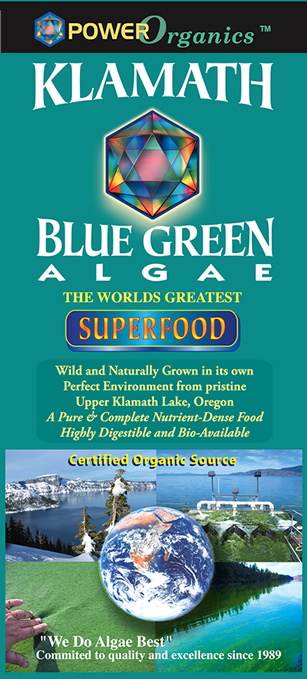
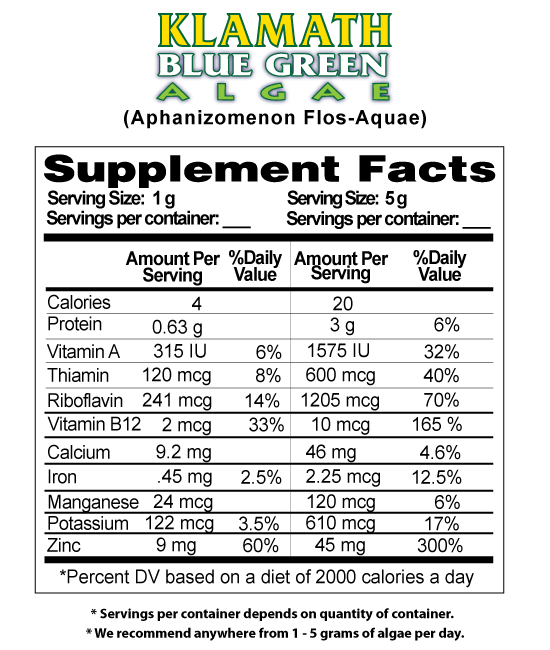
KLAMATHBLUE GREEN ALGAEProducts on ABOUT KLAMATH PRODUCTSto see this webpage in larger print, click here:Aphanizomenon Flos Aquae is harvested directly from the Upper Klamath Lake in Klamath Falls, Oregon in the summertime, when the algae is in full bloom (generally from June to November). Klamath Blue Green Algae is the most nutrient dense food on the planet, containing glyco-proteins, vitamins, minerals, simple carbohydrates, lipids and biologically active enzymes. Due to the algae's nutritious soft cell wall, these nutrients are readily available to the body. As the body uses only a small amount of energy to convert this superfood into fuel, consuming Klamath Blue Green Algae is a fast, efficient and energizing way to improve any diet. The discovery of the incredible food value concentrated in AFA, Aphanizomenon Flos Aquae, an ancient blue-green microalgae, has popularized this nutrient dense whole food that contains more protein, B12 and chlorophyll than any other food source. Klamath Blue Green Algae has such a complete nutritional profile, available in forms that are directly accessible and easily superior to any other algae on the market and has become the focus of much attention in the health food industry. The algae is harvested by a barge which scoops the algae from the lake. The algae then proceeds to the onboard collection tank where a process of filtration and dewatering occurs. The algae then goes to an insulated refrigerated stir tank that cools the algae to 35 degrees Fahrenheit. The algae is then put into a stainless steel refrigerated chill tank until it's transferred into a food grade tank and is transported to shore. The algae is then put through micro-filtration and purification processes and is immediately flash frozen and stored in the frozen state until the product is needed and released to be freeze dried and made into products . The algae is freeze-dried; temperature is maintained below 100 degrees, preserving vital enzymes and nutrients in their natural state. he serving size for the powder on the label is 1/4 tsp (1gram) the serving size for the tablets on the label is 2 tablets Q. What is the suggested
dosage for taking the algae? Q. Can I take too much algae? A. The algae is considered a whole food. Due
to the dense nutrient content of Klamath Blue Green Algae, A. The suggested time is first
thing in the morning on an empty stomach, even before coffee. You may
split them up It is important to remember that
the algae is considered a whole food, so you can eat it with other
vitamins,
Q. What are the side effects, if any? A. Used in the suggested dosage amounts, side
effects do not typically occur. However, some gastric upset A. Klamath Blue Green contains up to 70%
protein, more than any other whole food, in the shape and form
Spirulina, Chlorella, and Klamath Blue Green Algae:What is the Difference?Many people ask us about the difference between Klamath Blue Green Algae (Aphanizomenon Flos Aquae or AFA), spirulina and chlorella. AFA and spirulina are blue green algaes while chlorella is a green algae, which means it has an indigestible cellulose wall. This wall must be mechanically broken in order for the body to be able to digest it. This is a very expensive process and is reflected in the cost of the product. Spirulina and chlorella are cultivated in
man-made ponds whereas AFA is wildcrafted from Upper Klamath Lake Spirulina and Chlorella are usually heat
processed for commercial distribution. The cell walls of Spirulina are
Suggested Dosage: The suggested adult dosage is 1/4 tsp (1 gram) for the powder or 2 tablets for the tablet/Vcap form of Klamath Blue Green Algae. The best time to take the algae is first thing in the morning on an empty stomach. Some people prefer to split the dose; half in the morning, half in the afternoon. It is not recommended to take the algae at night unless you plan to stay up. Used in the suggested amounts, side effects do not typically occur. Due to the nutrient dense content of the algae, occasionally someone may experience over-stimulation. As the algae also works as a detoxifier. It is important to remember that
the algae is considered a whole food, so you can eat it with other
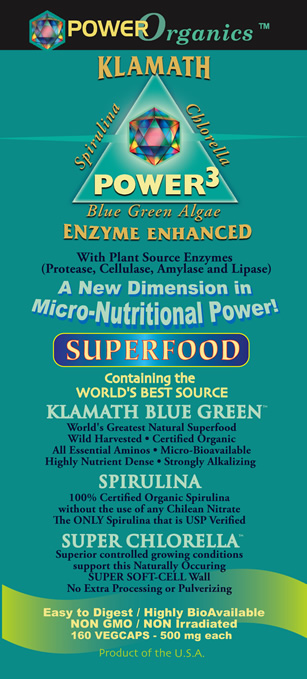
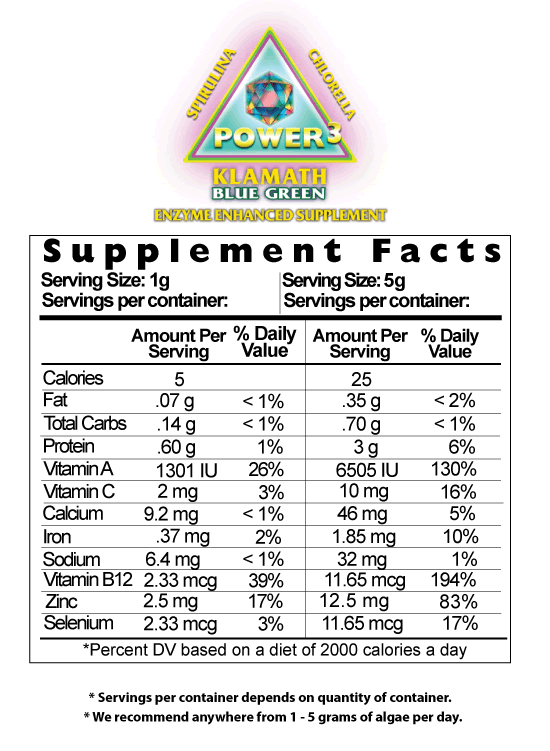
vitamins, medications or herbs. As always, POWER OF THREEKlamath Blue Green Algae, Spirulina, & Chlorella
Spirulina, Chlorella, and Klamath Blue Green Algae: What is the Difference? Many people ask us about the difference between Klamath Blue Green Algae (Aphanizomenon Flos Aquae or AFA), spirulina and chlorella. AFA and spirulina are blue green algaes while chlorella is a green algae, which means it has an indigestible cellulose wall. This wall must be mechanically broken in order for the body to be able to digest it. This is a very expensive process and is reflected in the cost of the product. Spirulina and chlorella are cultivated in
man-made ponds whereas AFA is wildcrafted from Upper Klamath Lake Spirulina and Chlorella are usually heat
processed for commercial distribution. The cell walls of Spirulina The suggested adult dosage is 1/4 tsp (1 gram) for the powder or 2 tablets for the tablet/Vcap form of Klamath Blue Green Algae. The best time to take the algae is first thing in the morning on an empty stomach. Some people prefer to split the dose; half in the morning, half in the afternoon. It is not recommended to take the algae at night unless you plan to stay up. Used in the suggested amounts, side effects do not typically occur. Due to the nutrient dense content of the algae, occasionally someone may experience over-stimulation. As the algae also works as a detoxifier. It is important to remember that
the algae is considered a whole food, so you can eat it with other
vitamins, medications or herbs. Mint Berry Clarity Raw Chocolate & Cacao Berry Clarity 1 oz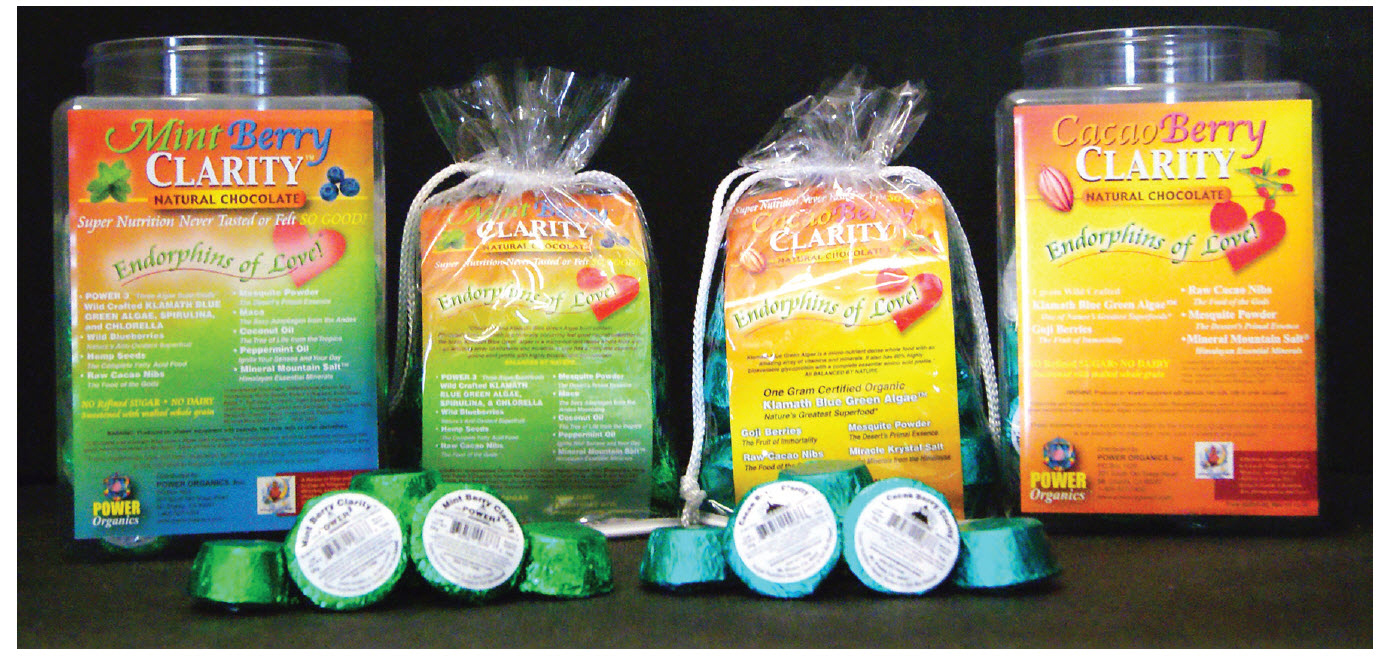
These heavenly cups are made up of cacao, blueberries, hemp seeds and peppermint oil, with a little crunch from cacao nibs and a few salt crystals that really satisfy that chocolate craving. So healthy for you, too, with blue-green algae, spirulina and chlorella. Sugar-free and dairy-free, made from all non-GMO ingredients. All wrapped up in pretty green paper lined foil. 10 - 1 oz/28 gram cups. 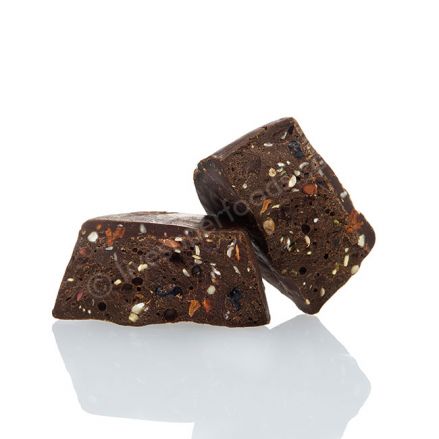
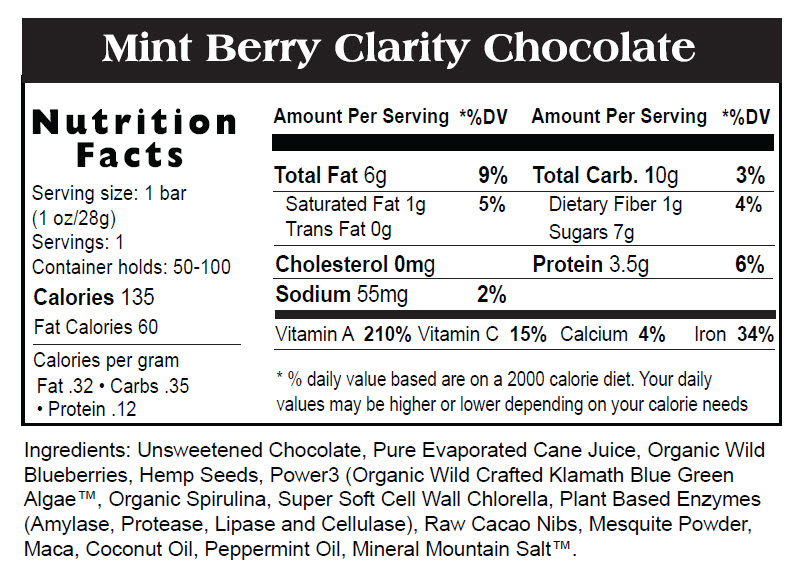
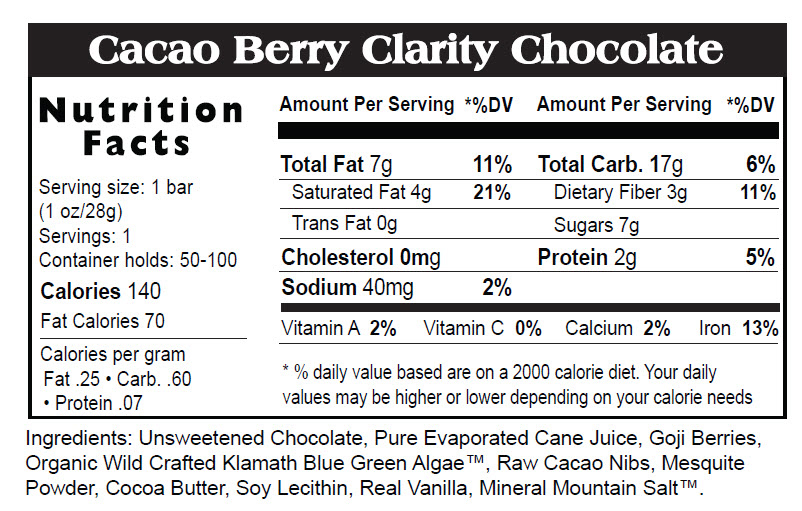 Super Nutrition Never Tasted or Felt So Good! These powerful, delicious, and super-nutritious ingredients explain why:KLA15 -
1 oz Cacao Berry Clarity Raw Chocolate
KLA16 - 1 oz Mint Berry Clarity Raw Chocolate
|