INFORMATION
ABOUT
SPIRULINA, CHLORELLA &
BLUE-GREEN ALGAE
 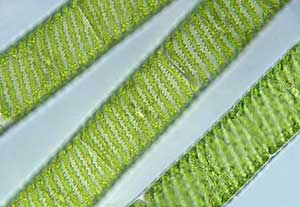 
Microscopic photos of green algae courtesy of
Microscopy-UK (https://www.microscopy-uk.org.uk)
Algae (singular alga) encompass several groups of
relatively simple living aquatic organisms that capture light energy
through photosynthesis, using it to convert inorganic substances into
organic matter.
Spirulina, Chlorella, and Klamath
Blue Green Algae:
What is the Difference?
Many people ask us
about the difference between Klamath Blue Green Algae (Aphanizomenon
Flos Aquae or AFA), spirulina and chlorella. AFA and spirulina are blue
green algaes while chlorella is a green algae, which means it has an
indigestible cellulose wall. This wall must be mechanically broken in
order for the body to be able to digest it. This is a very expensive
process and is reflected in the cost of the product.
Spirulina and chlorella are cultivated
in man-made ponds whereas AFA is wildcrafted from Upper Klamath Lake
where it grows in a pristine, mineral rich environment that cannot be
duplicated synthetically. The difference in energy one receives from
these whole foods is similar to the difference between cultivated
produce and foraged wild vegetables and fruits. In general, one needs
to take only a third as much AFA per day.
Spirulina and Chlorella are usually
heat processed for commercial distribution. The cell walls of Spirulina
are carmelized during spray drying, making it difficult for enzymes to
penetrate the algae cells during digestion. This results in low
assimilation of proteins and other nutritional components. Spray drying
can also kill enzymes, losing heat sensitive components and decreasing
beta-carotene due to the high temperatures that may be involved.
(Information taken from Klamath
Blue Green, Inc.'s website: www.klamathbluegreen.com)
A Note From Phil Wilson
Owner of Momentum98
A history lesson on...
The popularization of Algae in the U.S.
Spirulina
The rise of popularity of Spirulina in the U.S. can be attributed to
Dr. Christopher Hills. Dr. Hills did more than anyone in promoting the
benefits of Spirulina & Chlorella when he started writing books on
these Algae and began a company marketing Spirulina. He
also had a couple of interesting formulas, combining his Spirulina
(which he potentized) with other unique ingredients such as
bee pollen, ginseng, and even snake gall bladder extract. (I
remember reading about one of his stories about a man from Japan who
lived on chlorella alone for 15 years.)
In the
1970s Dr. Hills started a company whereby the products were sold
through a marketing structure then known as multi-level distributing,
and is now termed network marketing.This system works when
individuals discover a product through use and beneficial results.They
sign up as distributors and share the results and information with
friends and co-workers, who then may become distributors themselves.
News spread
about the many benefits of Spirulina, especially that this nutrient
dense Algae provides an excellent source of non-animal protein, as it
is high in B Vitamins. The world took note of this new wonder food.
Spirulina was grown in ponds in Hawaii, Mexico, Japan, and elsewhere,
and its popularity grew every year.
A few enlightened companies started putting Spirulina & other
Superfoods into their lines of vitamins. Rainbow Light began including
Spirulina and Chlorella in the base of most of their products by the
early 1980s. Sunasu Vitamins was the first vitamin company to put Super
Herbs in their vitamin formulations.
In
September 1981 the
headline NEW DIET AID: SPIRULINA appeared in the National
Enquirer. After
Spirulina made national news- everyone wanted it! Within one month of
the headline, fifty companies introduced their brands of Spirulina into Health Food Stores. It has been a staple Superfood
& Power Green ever since, found in many diet effective products
available in Health Food Stores.
Personally, I never considered Spirulina a diet aid. Yet, it
undoubtedly leaves you satisfied, and often when satisfied,
you might have a tendency not to over-eat.
Chlorella
A few
years later, the spotlight turned to Chlorella...
One of the most popular brands of Chlorella was made in Japan, and was
heavily advertised in the United States. Chlorella is interesting in
that, because of it's cell wall behind hard to dissolve, some kind of
process needed to be designed to half crack the cell wall so that we
humans could assimilate it. Eventually, another kind and brand of
Chlorella from Japan did appear in the US marketplace, which had a soft
cell wall, and did not have to be electronically cracked.But the demand
for that product was so great in Japan, that there was not any left in
the U.S.
Chlorella was selling like crazy in Health Food Stores all over the US
and then one day... that main company from Japan wasn't available
anymore. (I'm not sure what role the U.S. government played in
eliminating it. Rumors abound that it played a major role.)
And then a few years
ago, this Japanese product resurfaced in Health Food Stores in the U.S.
where it has to compete with many other companies, that had appeared in
its absence, marketing this Superfood.
The benefits of this very, very green Algae: it is very rich in
nutrients: including B Vitamins, Carotene, and Chlorophyll (obvious
from its deep green color). As you know chlorophyll is to plants as
blood is to animals / humans. People
have
been taking chlorella for sustained over-all energy, and they buy
it again and again.
Then, a new algae entered
the picture...
Blue
Green Algae
This particular Algae seems to grow only in particular places. The most
plentiful amount of this algae is in a lake in Oregon called Klamath
Lake. Just as Spirulina was popularized by word of mouth through a
network of independent distributors, the first Blue Green Algae was
sold in this manner by a company that surfaced in the mid 80s.
Currently, there are at least 3-4 different companies harvesting Blue
Green Algae from Lake Klamath. Klamath Blue Green Algae
manufactures the Blue Green Algae products that we have available. They
started harvesting in 1989.
Somehow,
some
way, Blue Green Algae gradually received the incredible press it deserved.
Possibly because it is so rich in amino acids that it goes directly to
the back of the head, and seems to be very effective in mentally
stimulating the human brain. (Better than coffee, I would say,
without the many negative side effects one finds with caffeine.)
Companies selling Spirulina decided to jump on the Blue Green Algae
bandwagon. Instead of putting Spirulina on their label, many of these
companies labeled their product, believe it or not, Blue Green Algae.
And it is true, Spirulina is a blue green Algae, in color. Yet,
Spirulina is not Aphanizomenon Flos Aquae. So if you
are taking a product labeled Blue Green Algae,
and
you are not getting an incredible mental clarity from the product,
but are feeling very fulfilled nutritionally from it especially in the
frontal area of the head - check your label. If the words Aphanizomenon
Flos
Aquae are not on the label, you are not getting what you
thought you might be getting.
Superfoods are here to stay.
Superfoods include products such as ginseng,
bee pollen, royal jelly, wheat grass, barley grass, many other
particular herbs too numerous to mention here, and the Algaes- Spirulina, Chlorella, & Blue
Green Algae.
This has been a brief, direct experience history
of the popularization of the Algaes from a person (me, Phil Wilson,
owner of Momentum98) immersed in the ingestion & dissemination
of not only the products, but information on them to the populace.
Exact dates have not been checked for accuracy, nor has there been
included here any scientific information about the benefits and the
specific nutrients contained in these mineral-rich plants. There
are many books, articles, and websites that provide this
information.
The intent of this article is not to impress you with what scientific
facts about Algae, because others have done that and admirably well.
Rather the purpose of this article is to inspire you, to excite your
imagination, to get you to jump into the World of Algae with
enthusiasm. Of course, one has to try the product first before one
truly becomes inspired. I personally eat all of these Algaes as one
might eat candy, or nuts, or seeds.
This is my summary of how these
Algaes affect my body:
Spirulina can be felt in the forehead
and above area of the head. It is very
rich in protein, and is very satisfying.
Chlorella can be felt
energizing the whole body: in every cell of the chest, head, legs,
everywhere with an even-keel energy.
Blue Green Algae, being
extremely rich in amino acids, seems to be a powerful mind & brain
stimulant, which gives remarkable mental clarity, and which can be felt
in the back or crown of the head.
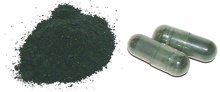
Combining all three of these algaes in one capsule is a very pretty
effective food (supplement).
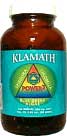
Check out
Klamath Power of Three:
Go to the
main Klamath Product Page
|
|