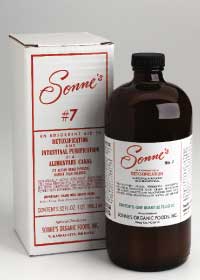
SONNE'S
NO.
7
DETOXIFICANT
Sonne's
Detoxificant is a natural and powerful detoxificant derived from
bentonite, a mineral-rich volcanic clay.
For centuries, native tribes around the world have recognized and
benefited from the healing properties of bentonite clay in internal and
external applications. In the early 20th century, bentonite clay was
used by the British Army in India to treat acute bacterial food
poisoning and in China to help treat cholera. We use a special process
to refine the raw bentonite clay to remove mica, dirt and other
impurities, in order to concentrate the active detoxifying ingredient,
montmorillonite ("mont-mor-ill-o-nite"). This procedure places
montmorillonite into a colloidal suspension and retains its innate
negative charge. These properties allow the powerful adsorption
(physical binding) of positively charged substances. (Most metabolic,
environmental, and chemical wastes are positively charged.)
Montmorillonite possesses the ability to adsorb about 40 times its own
weight in positively charged substances present in the alimentary
canal. Because montomorillonite has such strong absorptive properties
and is not digested, it tightly binds material to be excreted.
History of Use
Bentonite is not a new product. Primitive tribes of
various continents have been using volcanic ash for centuries for
various conditions of ill health. Primitives used to carry with them a
ball of bentonite clay, which they would mix with water. They would dip
their food into it before eating to prevent "sick stomach". Liquid
bentonite was used for centuries in China for summer diarrhea and
cholera. In 1712, Father Deutrecolle, a Jesuit Missionary, described
the clay works in China and mentioned that the clay (bentonite) was
used for diarrhea. The use of bentonite as an adjunct to medications
during the Balkan war of 1910 helped to reduce the mortality from
cholera among the soldiers from 60% to 3%, and also proved valuable in
the 1919 cholera epidemic in China. In India, bentonite was found
useful for acute bacterial food poisoning encountered by the British
Army. For over 50 years, we have made this ancient secret available for
modern man. Imagine, a natural clay that can draw pesticides, clean and
disinfect wounds, support immune function, and make food and water safe
for consumption - without side effects!
What is Bentonite?
Bentonite is a natural clay mineral formed in the
extreme heat and pressure of a volcano. In ages past, it was blown into
the sky by volcanic action, and sifted down to earth to help impregnate
the soil with its 25 - 35 trace minerals. Sometimes it accumulates in
layers or veins from which it is presently mined. Although bentonite
contains a rich amount of minerals, there is no evidence that we can
absorb any of its mineral content. Anyone who tries to sell the product
on the basis of the minerals in it is only guessing.
Many products on the market use bentonite in a raw
and unprocessed form. However, our bentonite is different. In making
our Detoxificant we start with the highest quality bentonite (U.S.P.
Grade), and mix it with purified demineralized water. During our
exclusive and secret process, the mica and impurities are removed, and
the purified montmorillonite is put into a liquid colloidal-gel state.
The product is sterilized and subjected to independent laboratory
analysis for heavy metals and microbiology, ensuring a substance
suitable for internal use and detoxification. It works better simply
because it is better.
Bentonite should never be packaged in plastic.
Because of its extreme drawing properties, bentonite can leach
petrochemicals from plastic bottles. That is why Sonne´s only
packages #7 Detoxificant in inert glass bottles.
The Expert's Opinion
Dr. Robert T. Martin is a mineralogist and one of
America´s outstanding authorities on bentonite. According to his
research, its action is due to five characteristics:
1. It has a large and varied mineral
content.
2. It has a negative electrical attraction for positively charged
particles.
In the human body, various toxic poisons are positively charged.
3. Seen under a high power microscope, bentonite is composed of
extremely minute rectangular particles
in the shape of a credit card. The wide surfaces are negatively charged
and the edges are positively charged.
Therefore, its adsorptive power is many thousand times more negative
than positive.
4. The very minuteness of its particles gives it a large surface area
in proportion to the volume used,
enabling it to pick up many times its own weight in positively charged
particles.
5. To obtain maximum effectiveness in the human body, it should be put
in a liquid colloidal-gel state.
This is why we do not keep it as powder or put it into a tablet form to
save shipping costs.
Dr. Martin stated that one gram (1/28 ounce)
of our product has a surface area of 800 sq. meters. This is 40 times
that of its commercial competitors. The larger the surface area, the
greater its power to pick up positively charged particles (toxins). An
edition of the Dispensatory of the United States of America states:
"In aqueous suspension, the individual particles
of bentonite are negatively charged, this resulting in a strong
attraction for positively charged particles and being responsible for
the ability of bentonite to clarify such liquid as contain positively
charged particles of suspended matter."
Since bentonite has such strong absorptive powers,
its consumption could theoretically render unavailable some nutrients,
as certain vitamins, by adsorbing them from the alimentary canal.
However, independent experiments designed to find out how much such
adsorption might adversely affect the growth and health of experimental
animals indicated no ill effects when the intake of bentonite was 25%
of the total diet. (Reference: Annals of the N.Y. Academy of Science,
Vol. 57, page 678). Our product is mostly water, with only a small
proportion of bentonite. In order for the bentonite in our product to
reach a toxic level (i.e., 50% of the total diet) it would be necessary
to consume a 3-year supply each day for an extended period of time.
Montmorillonite is classified as a hydrated aluminum
silicate. But, it is very different from the aluminum used in cooking
utensils, deodorants and other preparations. The aluminum molecule is
integral to the structure of montmorillonite, and cannot be removed by
normal digestive processes.
Recommended Dosage:
For average adults, take 1 tablespoon. For others, take 1 teaspoon for
each 50 lbs. body weight.
Directions:
Take 2 doses per day. The first one in warm water upon rising in the
morning; the other undiluted at time of evening meal. It is important
to drink plenty of water between meals to assist in elimination. It can
also be taken in conjunction with #9 Intestinal Cleanser in juice or
water. May be taken as long as desired